The Mighty Museum of the Earth
In an unassuming stretch of road connecting Trumansburg, New York to Ithaca, New York sits a similarly unassuming museum. However, inside are some of the best exhibits and the home to one of the largest collections of fossils in North America that leaves you wondering: what exactly is the story behind the Museum of the Earth?

The story begins back in the late 1800s, when Cornell University Professor Gilbert Harris first began publishing the Bulletins of American Paleontology (BAP). Eventually, he founded the Paleontological Research Institution (PRI) in 1932. By the early 1950s, paleontologist Katherine Van Winkle Palmer became the director, a position she held until 1978. During her reign, she moved the PRI to its current plot of land, helped publish dozens of scientific papers and issues of BAP, and became the first woman to win the Paleontological Society Medal. By the 1990s, plans were made to create a museum to showcase all of the amazing specimens- which now number over seven million- held by the PRI. Thus, the Museum of the Earth was born, opening in 2003, under the leadership of Director Warren Allmon and Associate Director Rob Ross.

As soon as you walk into the museum, you are greeted by the suspended skeleton of a North Atlantic Right Whale, collected after it tragically died from being caught in fishing nets. Past the entrance is the ramp leading to the main exhibits. As you walk down, you literally descend back into time thanks to the Rock of Ages, Sands of Time mural by Barbara Page. Each tile represents one million years of history and features different fossils. For instance, the first tile you see features human handprints- specifically, Page’s own. Some tiles down, still representing the Mesozoic, you see proboscidean tusks and an ancient camel. Sixty-five tiles into the artwork, you reach the menacing jaws of a Tyrannosaurus. All the way down near the bottom are some of the creatures from the Cambrian explosion, such as the trilobite Paradoxides. Each specimen is life size.

Right off the ramp is a cabinet featuring the Blaschka Glass Invertebrates, on loan from Cornell. They are exquisitely-crafted and life-size glass sculpts of marine invertebrates, which are well worth a look. Additionally, the rotating exhibit space is there.

After passing through a small exhibit discussing climate change and a window to observe employees working on real fossils, you enter the main portion of the museum. Just like Barbara Page’s art takes visitors backwards through time, the museum exhibits themselves take visitors back to the present. Starting at the Cambrian, the exhibit hall has a collection of exceptionally-preserved fossils from both the Burgess Shale in Canada and the Chengjiang biota from China. Among these are the famed fuzzy worm Canadia spinosa and the unusual Ottoia prolifica worm. The Cambrian is significant for the Cambrian explosion, which occurred around 530 million years ago. In addition to the worms, the first large amounts of complex life, including the earliest chordates like Haikouichthys, evolved around this time. In fact, most of the modern overarching animal groups alive today owe their beginnings to the Cambrian explosion. In a mere few million years, the oceans went from small, soft-bodied oddities to trilobites, tiny fish (the chordates mentioned), worms, and arthropods.

Right next to an amazing wall with a huge assortment of models and specimens showcasing the tree of invertebrate marine life is the eye-catching Devonian period fish, Dunkleosteus. But before we can move on to the Devonian, some amazing Silurian period fossils await. Most notably are the sea scorpions. Aside from being preserved exceedingly well, Eurypterus remipes is the state fossil of New York. The state was the site of the excavation of the first-ever sea scorpions. Despite this common name, these arthropods are actually closer to horseshoe crabs than to true scorpions. Also available for viewing from this time period are a nautiloid, algae, and a jellyfish-like hydrozoan.

The Devonian is known as the period wherein vertebrates made it onto land for the first time. Accordingly, the Museum has a small diorama with a lobe-finned fish model and early amphibian model crawling onto land. In terms of fossils, casts of some of these pioneering fish and amphibians are on display. Most famous among these is the “missing link” between fish and tetrapods, Tiktaalik roseae, and the amphibian Ichthyostega stensioei. A living lungfish is also cared for here, in addition to the Dunkleosteus armor bones.

While also presenting cast skulls of charismatic genera like Dimetrodon and Mastodonsaurus, the room housing the Permian exhibit really highlights the Permian-Triassic extinction (P-T), otherwise known as the end-Permian or “The Great Dying.” This last name is as accurate as it is dramatic; it is the worst mass extinction event in the history of our planet. By most metrics, such as families of animals, sea organisms, and species in general, the P-T event holds the crown for most extinctions of any of the six (including today) largest mass extinction events in Earth’s history.
The destruction at the end of the Permian is also the boundary between the Paleozoic and Mesozoic eras. The Mesozoic era is, famously, the geologic time where dinosaurs evolved. In the Triassic period, Earth has just one massive landmass, known as Pangaea. In this arid landscape, relatives of what would become crocodilians were the dominant life forms. Dinosaurs were relegated (mainly) to the shadows. One such smaller dinosaur was Coelophysis bauri, whose fossils have primarily been unearthed in the southwest portion of the United States. However, footprints similar to Coelophysis were found in New York. Despite the state’s rich fossil discoveries, no dinosaur bones have been found. These footprints, technically given the name Grallator, were left behind by some sort of small, early bipedal dinosaur. If not Coelophysis itself, it was probably something that looked very similar and was very closely related to them. Grallator is an ichnogenus; simply a way to help categorize footprints as they cannot be definitely linked to a specific known species. The Museum rightly highlights Coelophysis, showcasing footprints, a cast of a famous specimen, and three distinct models that display how our understanding of the genus has changed over decades. Additionally, the logo used by PRI and the museum feature a running Coelophysis, and visitors are greeted by a statue of the mascot, Cecil A. Physis, a life-size, cartoon Coelophysis.

The Triassic section and adjacent Jurassic also highlight local fish and murals depicting life in those times. A life-sized papier-mache model of a Stegosaurus. This model was originally built in 1904 and spent over a hundred years at the Smithsonian National Museum of Natural History in Washington, DC. While not very accurate by today’s standards, the impressive sculpture is a testament to the earlier days of paleoart and the evolution of our understanding of dinosaurs. A more modern statue of the Cretaceous pterosaur Quetzalcoatlus soars above the room.

The Cretaceous room, the last part of the Mesozoic, features specimens such as an imposing Tyrannosaurus skull and an iconic cast of an Archaeopteryx (which is from the Jurassic). Arguably the most impressive, however, is the ammonite fossil. One of the largest known of its kind, this Diplomoceras was originally found in Antarctica and features an intriguing, paper clip-like shape. Also highlighted is the end-Cretaceous mass extinction, also known as the K-Pg or, formerly, K-T event. In addition to all of the non-avian dinosaurs, a giant asteroid wiped out noteworthy groups such as pterosaurs, mosasaurs, plesiosaurs, and ammonites. The world was never the same, but the ecological niches left behind were filled with new animals, including a hugely diverse set of mammals.

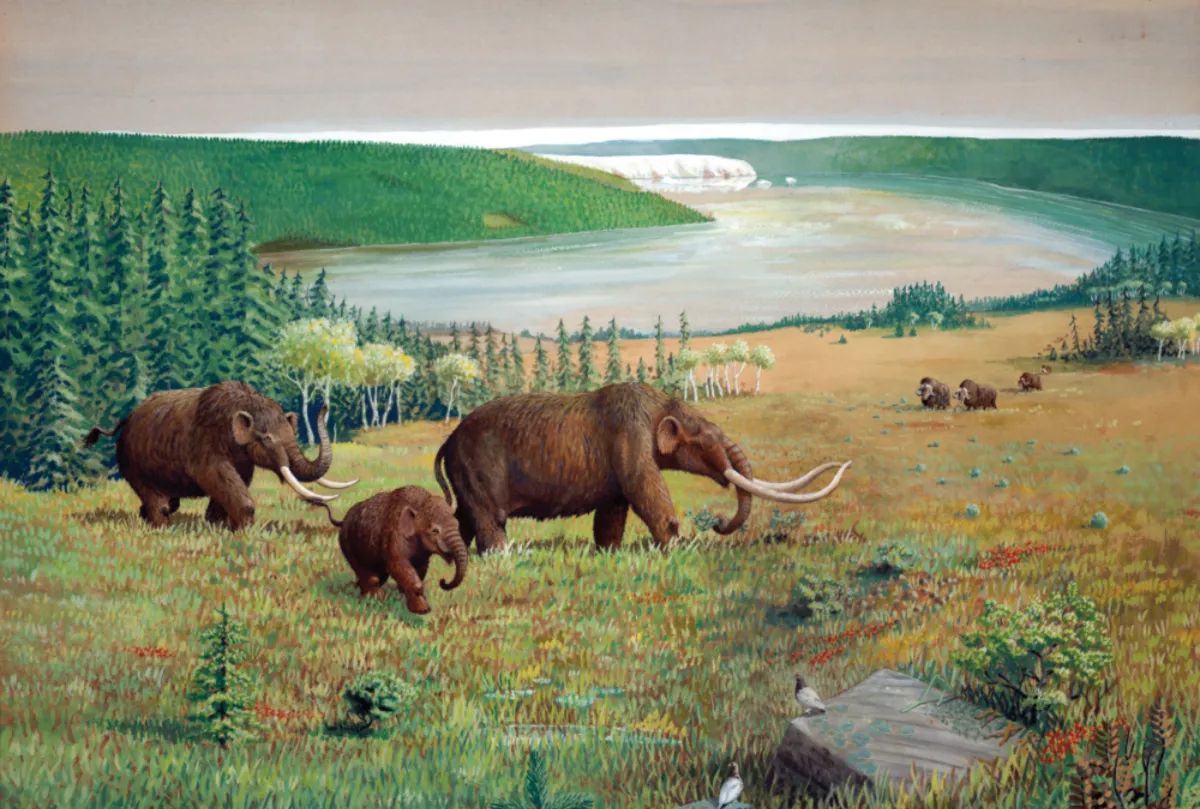
Entering the final section with fossils is the room with the star attraction, the Hyde Park Mastodon. Found in a family’s background pond in the Hudson Valley, the excavation was a joint effort between the Hyde Park local community volunteers, amateur fossil fiends, experts from other organizations, and the PRI. This occurred in the few years preceding the opening of the Museum of the Earth, and the majestic beast has been capturing imaginations since opening day. Alongside the mammal sits the trunk of a spruce tree recovered from the same pond (though not deposited at the same time). The tree was so well-preserved that it had to be slowly desiccated over a laboriously long time to prevent it from being destroyed. The species of tree is, nowadays, found much further north. This range indicates that, when the tree was deposited, temperatures in the Hudson Valley were much colder than they are now, more akin to certain areas in Canada. To exit, you pass through a glacier exhibit, which talks all about the formation, flow, and recession of glaciers during the last ice age. In Ithaca, NY, for example, the ice sheet was over 2 miles thick.

Overall, the Museum of the Earth does a stellar job of showcasing the global story of life on Earth, from the earliest soft-bodied organisms through the dinosaurs and mammal ice age megafauna to the humans of today. In the process, exhibits help to emphasize New York state’s unique fossil history, featuring the state fossil, the only dinosaur evidence in the state, and an iconic ice age denizen of the area. If you ever find yourself on that unassuming stretch of road near Ithaca, NY, it is well worth stopping by this extraordinary museum.

References:
https://www.museumoftheearth.org/about/about-the-museum
https://www.priweb.org/history-copy
https://www.museumoftheearth.org/daring-to-dig/bio/katherine-palmer-new
https://www.museumoftheearth.org/exhibit/rock-of-ages-sands-of-time
https://www.museumoftheearth.org/exhibit/north-atlantic-right-whale-2030
https://www.museumoftheearth.org/exhibit/steggy-the-stegosaurus
Photos:
https://burgess-shale.rom.on.ca/fossils/canadia-spinosa/
https://www.museumoftheearth.org/exhibit/rock-of-ages-sands-of-time
https://www.museumoftheearth.org/glaciers/ithaca-was-glaciers