
Welcome to Scooby's Prehistory Archives!
Towering Rodents: Beavers, Capybaras, and More!
A few descriptors no doubt come to mind when you hear the name “rodent”: dirty, scary, and, most of all, small. However, Rodentia is a highly diverse group of animals; in fact, over 40% of mammal species are rodents. The group is much more than just rats or mice. Squirrels, chipmunks, and beloved pets like guinea pigs or hamsters are all rodents that millions of people see daily. On the more wild side, rodents like the greater capybara and North American beaver are known for their large size. Caimans generally leave capybaras alone in the Amazon due to their heft and incisors, and beavers can fell trees over 100 inches in circumference. While both capybaras and beavers are definitely large, some prehistoric rodents were even larger. Below, we’ll look at some giant extinct capybara and beaver ancestors, as well as another large rodent in the Dinomyidae family.

The largest rodent ever looks superficially similar to a modern capybara, though they were not particularly close in size. The giant Josephoartigasia monesi was truly massive, though at what exact size is contested. According to Russell Engelman, early estimates turned up gargantuan sizes of around 2600 lbs (1200 kg) based on a skull. This amount is over twice as much as the average mature cow. However, more modern estimates have generally lowered, mainly around a range of 1370-2020 lbs (620-915 kg)- still larger than the average adult cow, but by a lesser amount. Engelman also mentions some low modern estimates place the weight of J. monesi at 770 lbs (350 kg). However, in 2022, Engelman himself used more conservative techniques to conclude an estimated weight of 320-560 lbs (145-225 kg). This weight, while smaller, is still massive for a rodent, coming in at 2-4 times the weight of an average male capybara. As mentioned, J. monesi was not exceptionally close to capybara despite its size. Its closest modern cousin is the 33-pound (15-kg) pacarana, which is within the family Dinomyidae. Dinomyidae, in turn, is nestled within the Chinchilloidea clade, or group. This status means that, after the pacarana, this behemoth’s closest living relatives are the pint-sized chinchillas! The long-tailed chinchilla can only reach the Lilliputian size of 1-1.67 lbs (450-750 grams). Despite its fearsome size, J. monesi was herbivorous. It lived in watery environments of what is now Uruguay, not unlike the type of terrain occupied by capybaras today. It is known from a well-preserved skull, and, like all rodents, its skull was highlighted by a pair of large, ever-growing incisors.

Before J. monesi rumbled onto the scientific scene, however, the “largest-ever rodent” title was given to Phoberomys pattersoni. Much like J. monesi, historical estimates are likely too liberal, but modern research still remains at a healthy 130-165 lbs (about 63-73 kg) weight range. Much smaller than J. monesi, and, in fact, even a bit smaller than the largest modern capybara specimens.
Speaking of capybaras, the greater capybara (Hydrochoeris hydrochaeris) is notable as being the largest living rodent species. Described by PBS as a “barrel with legs,” adult males can reach weights of up to 175 lbs (80 kg) and get to 4 ft (1.2 m) long and 2 ft (0.6 m) high at the shoulder. For reference, adult female white-tailed deer are generally around the same weight. H. hydrochaeris is known to spend lots of time resting and wading along waterbanks and are so large that they were originally thought to be a type of pig. Despite their large size, H. hydrochaeris is a full-fledged herbivore, spending much of the day searching for water plants and grasses to eat. As mentioned in the introduction, caimans generally leave these rodents alone despite habitat overlap. They are simply too large to be regularly eaten by the reptiles; in fact, adult capybaras' only known predators are jaguars and humans.

While true capybaras- described as those within the subfamily Hydrochoerinae- are now a South American staple, many large members of the group lived in both Central and North America. A bit more than 3 million years ago, the isthmus of Panama rose above sea level and connected North and South America. In an event known as the Great American Biotic Interchange (GABI), animals from both sides moved north and southward to settle in new lands. As an example, a group of camelids traveled south and eventually led to the modern llamas. Capybaras, meanwhile, went north through Central America. Take Neochoerus pinckneyi, for instance. This rodent has been found in both Mexico and the United States, but also as far south as Colombia. It was a bit larger than H. hydrochaeris, but did not reach the gargantuan sizes of J. monesi. The genus Neochoerus is also represented by N. aesopi. Both species are known in deposits throughout what is now the United States. Another North American genus, Phugatherium, is also known. For many years, these were the only capybaras known from North America; Hydrochoeris was only known from its modern South American home. In 2022, however, White et al. described the remains of a new species of Hydrochoeris: H. hesperotiganites. This species was known from California and was determined to belong to Hydrochoeris due to specific characteristics of the incisors and jaw that are unique to the genus.

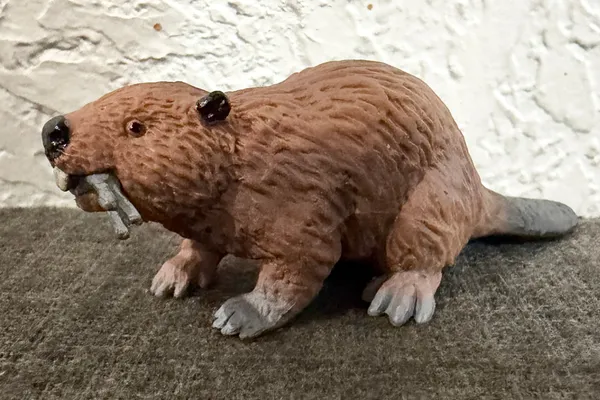
The largest extant North American rodent is the North American beaver, whose scientific name is Castor canadensis. C. canadensis reaches lengths of up to 4 ft (1.2 m) and generally weighs between 40-70 lbs (17-32 kg), with exceptionally large beavers capable of surpassing 100 lbs (45 kg). C. canadensis can be found from northern Yukon, Canada, all the way down to parts of Mexico. C. fiber is its European counterpart, but it is smaller than C. canadensis. As mentioned in the introduction, beavers can use their large front chompers to fell trees that are over 8 ft (2.5 m) in circumference. However, they are so much more than that. Beavers play irreplaceable roles in many river ecosystems by building dams, creating ponds, curtailing flood risk, and even increasing biodiversity. Wetlands are created and shaped by beavers; prior to European presence in America, beaver-produced wetlands accounted for over 300,000 square miles (777,000 square km) of land.

So, beavers are titans in size (for a rodent) and environmental impact. However, they are also celebrated culturally. For thousands of years, indigenous people in North America hunted the beaver for fur and food. This practice was continued by European settlers, which almost drove the beaver to extinction. Fortunately, C. canadensis persevered. Today, it is revered as the state animal of Oregon and the national animal of Canada. Its likeness is used on the backside of the Oregon state flag, Canadian coins, and as the mascot for the athletic teams of many colleges and universities. A beaver was even the mascot of the 1976 summer Olympics in Montreal.

While C. canadensis holds a massive presence in North America, it is not the largest beaver of all time. While not part of the genus Castor, Castoroides lies within the beaver family Castoridae. Castoroides is the largest beaver of all time and one of the largest rodents ever. A variety of species were known, including the type species C. ohioensis. However, according to research by Hulbert et al., only one other species should be regarded as valid: C. dilophidus, whose fossils have been found primarily in the southeastern United States. C. ohioensis, on the other hand, has a fairly wide range. And while they are in the same family, they do have some physical differences and are not necessarily very closely related. The most obvious of these differences is the tail; rather than the classic beaver tail, Castoroides has a much thinner, longer tail. In terms of size, C. ohioensis likely did not reach the sizes of Josephoartigasia but was still larger than the largest beavers today. As is a trend in some of the prehistoric rodent sizes above, initial estimates were placed well above what modern science says. Originally described as “black bear-sized,” C. ohioensis was likely closer to 130-220 lbs (60-100 kg), according to Reynolds. Still large, but not as gargantuan as previously assumed.
Rodents come in all shapes, and as these truly giant rodents show, sizes. From the humble house mouse all the way up to the larger-than-life Josephoartigasia monesi, the rodent size range is far beyond what initially meets the eye. Even modern marvels like the greater capybara and North American beaver reach surprising sizes, but all of these ginormous members of Rodentia help to illustrate the size diversity of the group.

P.S. Isa loves Beavers.
Sources
Alaska Department of Fish and Game. “Beaver Species Profile, Alaska Department of Fish and Game.” Www.adfg.alaska.gov, www.adfg.alaska.gov/index.cfm?adfg=beaver.printerfriendly.
Barkley, Amy. “Keeping the First Calf Heifers on Track by Parker Henley, OK State - Southwest New York Dairy, Livestock & Field Crops Program - Cornell University - Cornell Cooperative Extension.” Cornell.edu, 2021, swnydlfc.cce.cornell.edu/submission.php?id=1289&crumb=livestock%7C10.
Hulbert Jr, Richard. TAXONOMY OF THE PLEISTOCENE GIANT BEAVER CASTOROIDES (RODENTIA: CASTORIDAE) FROM THE SOUTHEASTERN UNITED STATES.
Kay, Emily H., and Hopi E. Hoekstra. “Rodents.” Current Biology, vol. 18, no. 10, May 2008, pp. R406–R410, https://doi.org/10.1016/j.cub.2008.03.019.
National Park Service. “Shapers of a Continent - Gates of the Arctic National Park & Preserve (U.S. National Park Service).” Www.nps.gov, 2021, www.nps.gov/gaar/learn/nature/shapers-of-a-continent.htm.
Oregon Department of Fish and Wildlife. Oregon Department of Fish and Wildlife Fact Sheet: Oregon’s State Mammal.
Parks Canada Agency. “Beavers: 5 Ways Beavers Keep Our Ecosystems Healthy.” Parks.canada.ca, 1 Nov. 2019, parks.canada.ca/pn-np/mb/riding/nature/animals/mammals/castors-beavers.
PBS Nature. “Capybara Fact Sheet | Blog | Nature | PBS.” Nature, PBS, 14 Aug. 2023, www.pbs.org/wnet/nature/blog/capybara-fact-sheet/.
Reynolds, P. S. “HOW BIG IS a GIANT? THE IMPORTANCE of METHOD in ESTIMATING BODY SIZE of EXTINCT MAMMALS.” Journal of Mammalogy, vol. 83, no. 2, May 2002, pp. 321–332, academic.oup.com/jmammal/article/83/2/321/2373089, https://doi.org/10.1644/1545-1542(2002)083%3C0321:hbiagt%3E2.0.co;2.
Rinderknecht, Andrés, and R. Ernesto Blanco. “The Largest Fossil Rodent.” Proceedings of the Royal Society B: Biological Sciences, vol. 275, no. 1637, 15 Jan. 2008, pp. 923–928, https://doi.org/10.1098/rspb.2007.1645.
River Keepers of Fargo-Moorhead. “Beavers.” Riverkeepers.org, www.riverkeepers.org/wp-content/uploads/2016/07/Beavers.pdf.
White, Richard, et al. “New Record of Capybara (Rodentia: Caviidae: Hydrochoerinae) from the Pleistocene of San Diego County, California with Remarks on Their Biogeography and Dispersal in the Pleistocene of Western North America.” Vertebrate Anatomy Morphology Palaeontology, vol. 9, no. 1, 28 Feb. 2022, pp. 131–155, https://doi.org/10.18435/vamp29379.
Photo Sources
https://www.britannica.com/animal/capybara-genus
https://nature.ca/en/bucky-the-giant-beaver-awaits-adoring-fans/
https://gurneyjourney.blogspot.com/2009/10/mega-rodent-part-1.html


Subscribe to Scooby's Prehistory Archives
Never miss a new chance to learn about prehistory!
Copyright 2026. Richie The Dino. All Rights Reserved.